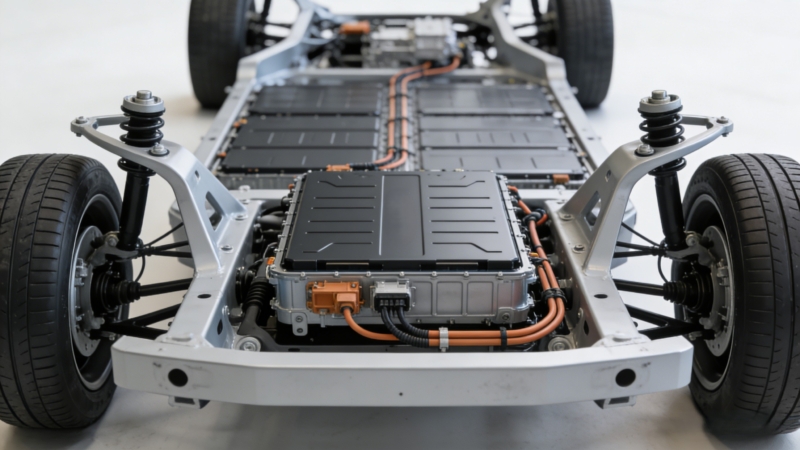
Eve Energy, a battery supplier to automakers including Tesla, BMW, and Mercedes-Benz, announced that its Longquan No.3 and Longquan No.4 solid-state batteries (SSB) have rolled off the production line at its Chengdu facility. The development marks a step toward commercialisation readiness in its multi-route solid-state program, according to IThome.
Technical positioning
The two cells target distinct applications. The Longquan No.3 is positioned for consumer electronics and operates under stack pressure below 2 MPa to maintain solid–solid interface contact, a key constraint in SSB design. The company highlights high volumetric energy density, though specific figures were not disclosed.
The Longquan No.4 targets EV traction applications. It features a cell capacity of 60 Ah and can cycle under stack pressure at or below 5 MPa, indicating progress toward automotive-relevant operating conditions. Details on battery chemistry beyond its classification as a fully solid-state system were not provided.
Battery pack capacity, charging performance, and energy density metrics for both variants were not stated in the source.
Product evolution
The new cells follow the earlier Longquan No. 2, part of a structured iteration strategy spanning the consumer, EV, and energy storage segments. That earlier generation targeted robotics, low-altitude aircraft, and AI hardware, reflecting the company’s broader positioning across emerging electrification use cases.
Backstory: In September 2025, the company launched its Chengdu solid-state pilot base and introduced the Longquan No.2 cell, establishing its SSB development roadmap and initial manufacturing validation.
Industry context
The rollout comes as battery suppliers attempt to reduce stack pressure requirements while maintaining stable solid–solid interfaces, a key barrier to SSB commercialisation. Lower pressure thresholds are associated with improved manufacturability and integration into vehicle platforms supplied to global OEM customers.
Eve has established supply relationships with automakers, including Tesla and BMW, and participates in a commercial vehicle battery joint venture with Daimler Truck, Cummins, and Paccar, positioning it across both passenger and commercial EV supply chains.
Other foreign automakers have backed Chinese battery firms in parallel: Mercedes‑supported Farasis Energy delivered a first-generation sulfide solid-state battery with 400 Wh/kg in 2025, while Volkswagen-backed Gotion finalised a 2 GWh solid-state line in 2026, targeting EV deployment. These examples illustrate a broader trend: OEM-backed Chinese suppliers accelerating the adoption of solid-state batteries.
Market outlook
The company did not disclose commercialisation timelines or customer deployment plans for Longquan No. 3 and No. 4. No official price has been announced.
The announcement focuses on early-stage production validation rather than mass deployment. Remaining uncertainties include scalability, progress on automotive qualification, and integration into EV platforms.

Recommended for you

Solid-state patent: CATL tackles sulfide instability ahead of 2027 pilot

China ignites solid-state battery race: production expands in 2026, vehicle demonstrations by 2027
Follow us for ev updates