


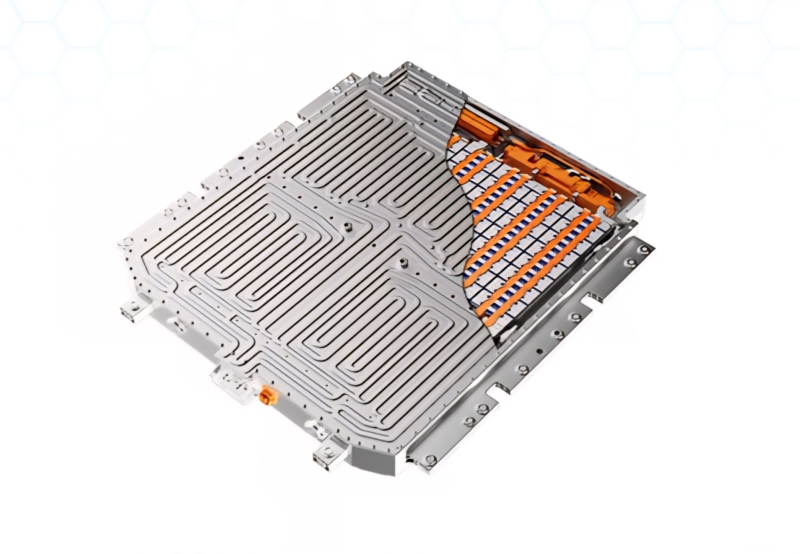
Svolt announced its Dragon Armor 3.0 battery can achieve “fire and electricity separation” for the first time – physically separating the terminals (electricity) from the pressure relief channels (fire). This allows for the directional expulsion of flames during thermal runaway, away from the passenger compartment in a vehicle.
More specifically, the positive terminal is on one side, and the pressure relief channel for fire is on the other side, providing physical isolation, with each having its own separate path. During thermal runaway, the flames are directed downwards and away, never towards the passenger compartment, according to Svolt.
Svolt also claimed its Dragon Armor 3.0 is the first to achieve compatibility between square battery cells and CTC/CTB (Cell-to-Chassis/Cell-to-Body) integration with thermal management separation. The overall battery capacity is increased by 7% to 10% for the same package size, and the cell height is increased by 5 mm. The top of the battery cell can withstand force, while the bottom allows for pressure relief and shared space for collision protection.
Combined with liquid-solid state technology, the Dragon Armor 3.0 also has an 8℃ increase in self-heating temperature of the battery cell, a 10% increase in safety buffer time, a 5℃ increase in thermal runaway initiation temperature, and a 25% reduction in the probability of thermal runaway.
The Dragon Armor 3.0 will soon enter mass production with two battery pack options: an 86 kWh pack for plug-in hybrid vehicles and a 115 kWh pack for all-electric vehicles.
In particular, the 86 kWh pack’s battery life is increased by over 10% and the pure electric driving range exceeds 400 kilometers.
About Dragon Armor Battery
The Dragon Armor Battery system was first launched by Svolt on December 15, 2022. The battery can realize a pure electric range of up to 800 km in LFP applications and can support 4C fast charging in NCM applications.
Source: Svolt
Follow us for ev updates