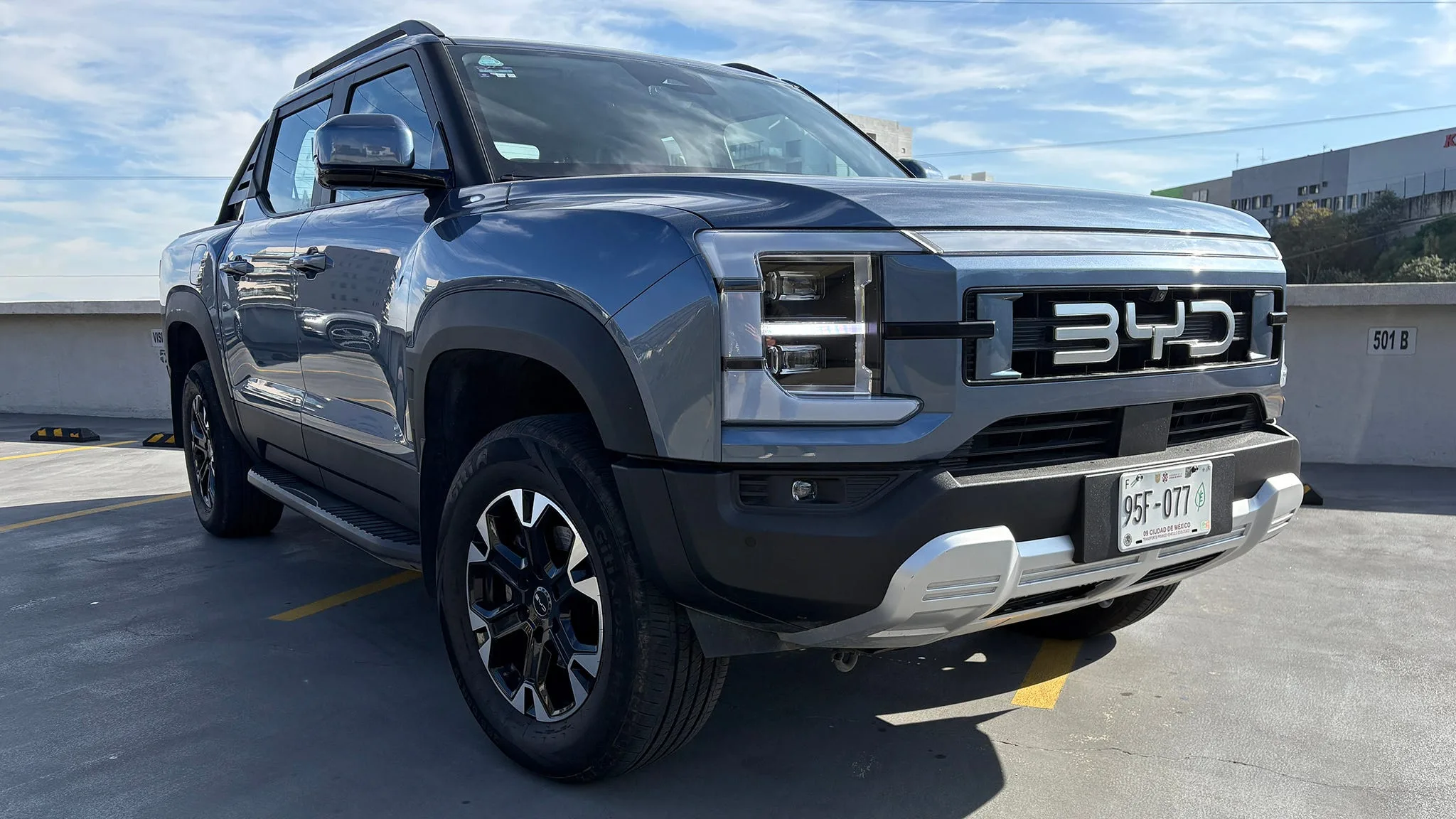

The BYD Shark drew significant attention at its debut, not just because it was BYD’s first pickup truck, but because it sent a clear message to traditional automakers: It’s here to disrupt the segment. Directly competing in various markets with the Toyota Tacoma, Ford Ranger, and Chevrolet Colorado, the 2025 BYD Shark stands out in its class as a pickup offered only with a plug-in hybrid powertrain, and it undercuts its rivals by several thousand dollars. While it lacks a full transfer case and makes do with an all-wheel-drive system, the Shark’s body-on-frame construction still enables it to tow and haul serious loads.
We spent a week driving the BYD Shark in Mexico City, a sprawling metropolis that doesn’t exactly seem like the ideal place to explore a pickup’s full range of abilities, but it turned out to be more apt than originally thought due to the broken roads and thick traffic. We came away impressed by this truck’s ride quality, solid construction, fuel efficiency, and overall interior experience. The Shark feels comfortable navigating city streets, and it holds its own against more traditional pickup trucks in this scenario.
ADVERTISEMENT – CONTINUE READING BELOW
No Full-Time 4×4, So What?
The Shark isn’t a carbon copy of what Chevrolet, Ford, or Toyota offer. Instead, it brings a plug-in hybrid powertrain that allows for roughly 60 miles of electric-only driving and an estimated 522 miles of total range when combining the battery and gas tank. Both figures are based on the optimistic New European Driving Cycle, so real-world results are likely lower. During our time with the Shark, the battery dipped to about 23 percent, the lowest level we observed, before the gas engine stepped in.
Anyone who has traveled to Mexico City knows its streets are poorly paved, with speed bumps, ruts, and potholes everywhere. Think “nonexplosive minefield,” and you wouldn’t be wrong. Yet the Shark shrugged everything off with ease, its dampers expertly filtering out harsh impacts and transmitting only minimal vibrations to the cabin.
ADVERTISEMENT – CONTINUE READING BELOW
With Mexico City’s infamous traffic jams, the Shark’s plug-in hybrid powertrain proved to be a natural fit. In bumper-to-bumper traffic, the truck operated mostly in electric mode, seamlessly blending in gasoline power once traffic began to flow. The hybrid system was smooth and quiet, and at times the transition between electric and gas power was so subtle we barely noticed the engine switching on or off.
The Shark uses its 1.5-liter turbocharged gasoline engine purely as a generator, powering a 29.6kWh9.6kWh battery that feeds9.6kWh battery that feeds battery that feeds two electric motors to produce a combined 430 hp and 480 lb-ft of torque. Those are stout numbers for a midsize pickup, and BYD claims a 0–62-mph sprint of 5.7 seconds. That’s genuinely quick for the segment. For context, in MotorTrend testing a 2024 Toyota Tacoma Limited with a four-cylinder hybrid reached 60 mph in 7.2 seconds, while a 2021 Ford Ranger Tremor with a V-6 completed the 0–60 run in 6.3.
ADVERTISEMENT – CONTINUE READING BELOW
BYD chose to forgo a traditional mechanical drivetrain in the Shark. While the exact reasoning hasn’t been disclosed, it’s likely a recognition that most buyers won’t be rock crawling or tackling extreme trails. Instead, the Shark is rear-drive with an all-wheel-drive system that should be sufficient for light off-roading. It also offers three selectable traction modes—Mud, Sand, and Snow—that tailor the traction control system to conditions.
On the road, the Shark proved to be a capable and confident truck. Its ride quality stood out by keeping vibrations out of the cabin, while its solid build gave it a sense of composure over just about any surface. On twisty roads, it remained comfortable, with respectable body control for a truck of its size. The commanding seating position was especially helpful in a city as congested as Mexico City, giving us better visibility and making it easier to navigate traffic.
ADVERTISEMENT – CONTINUE READING BELOW
A Shark’s Insides
We’ve previously noted that BYD’s interiors are of high quality, and the Shark’s is no exception. The switchgear draws inspiration from aircraft cabins, while the center console is flanked by two substantial grab handles. In Mexico, BYD offers the Shark in GL and GS trims, and we sampled the range-topping GS model, which features orange stitching and matching accents around the air vents and center console. A dashboard tray in front of the passenger is large enough to hold wallets, keys, or sunglasses, freeing up space in the center console.
A massive 12.8-inch touchscreen can rotate between horizontal and vertical orientations, though Apple CarPlay and Android Auto only function when the display is set horizontally. While we didn’t get a chance to try it, the Shark is also equipped with NFC technology, allowing drivers to unlock and start the vehicle without carrying a physical key.
The Shark is a midsize truck, and although its cabin isn’t as expansive as something like a Ford F-150’s, it’s still impressively spacious. Front-seat occupants will have no complaints, and rear-seat passengers should be comfortable, as well. A flat rear floor gives the middle passenger extra legroom, and those in back also get air vents, two USB ports, and a 110-volt power outlet to keep their devices charged.
The Truck Stuff
One could argue that the Shark’s exterior bears some resemblance to the Ford F-150, and BYD has also borrowed Ford’s idea of a built-in tailgate step, albeit without the assist handle found on the Ford. Tucked neatly into the tailgate, the step deploys once the tailgate is lowered by pressing a button that releases the mechanism. Pull it out, and climbing into the bed becomes noticeably easier.
ADVERTISEMENT – CONTINUE READING BELOW
One notable omission is additional tie-down hooks. The Shark comes with four—one at each corner of the bed—and while that may be sufficient for many users, a couple more along the bed’s midsection would be welcome. A button on the tailgate activates bright bed lighting, which proved especially handy at night. The bed also includes three 110-volt outlets, making it useful for camping or jobsite duty. Even better, the Shark features vehicle-to-load capability, allowing its battery pack to function as a portable generator—that can be recharged by the engine—when the power goes out.
Payload and towing figures land squarely in the middle of the segment. The Shark is rated to tow up to 5,510 pounds, roughly 1,000 pounds fewer than the Toyota Tacoma. Payload capacity checks in at around 1,700 pounds, putting it right in line with the Toyota. We didn’t have the opportunity to test either figure ourselves, so we can’t comment on how the truck behaves at these limits.
Is the BYD Shark the Apex Predator of Pickups?
While BYD has equipped the Shark differently than most traditional pickup trucks, it’s still generating plenty of interest. Its biggest differentiator, as with many Chinese vehicles, is price. BYD isn’t currently sold in the U.S., but in Mexico the Shark GL starts at 899,980 pesos (about $50,060 at today’s exchange rate), while the range-topping GS comes in at 969,900 pesos ($53,949).
ADVERTISEMENT – CONTINUE READING BELOW
For that money, you could buy a Toyota Tacoma SR 4×4, which makes just 228 hp and doesn’t offer any form of electrification. Stepping up to a Tacoma TRD Sport Premium with the hybrid powertrain pushes the starting price to 1,167,500 pesos (about $64,940). Ford, meanwhile, doesn’t offer a Ranger hybrid in Mexico and sells its top-trim, 270-hp Ranger Wildtrak for 960,900 pesos ($53,448). That’s a clear value advantage for the Shark, which also delivers significantly more power and a standard plug-in hybrid powertrain at a price its rivals simply can’t match.
We were genuinely impressed by how the Shark navigated Mexico City, and it’s easy to see why it has quickly captured the attention of local buyers. In less than three years, BYD has established itself as one of the leading Chinese automakers in Mexico, and the Shark showcases how the brand is adeptly tackling a segment that’s among the toughest to succeed in, no matter where in the world you live. We’d certainly be interested in testing one more thoroughly on our home turf.