


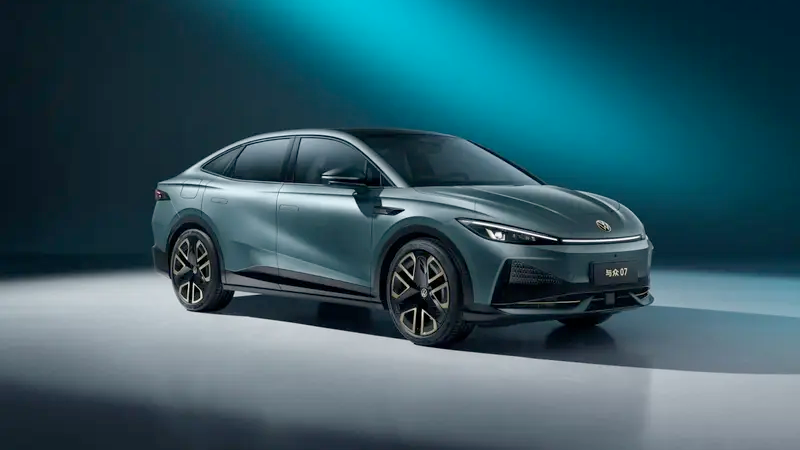
Volkswagen‘s first vehicle based on the China Electrical Architecture (CEA) is set to begin production on December 31 at Volkswagen Anhui, marking a milestone in the German automaker’s China strategy. The vehicle, known as ID.Unyx 07, was developed primarily by a Chinese team and represents a complete development chain from electrical architecture to vehicle integration, accomplished in 18 months. The development cycle in Europe is often significantly longer than this.
Han Sanchu, Executive Vice President of Volkswagen Group China and CEO of Cariad China, recently announced that the CEA architecture, jointly developed with Xpeng, has a clear roadmap. After the initial CEA 1.0 version launches this year, version 2.0 will follow in 2027, supporting multiple powertrain types, and version 3.0 is planned for 2029 with deeper SOC chip development capabilities, establishing a two-year upgrade cycle.
The collaboration between Xpeng and Volkswagen began in July 2023 when Volkswagen invested 700 million USD for a 4.99% stake in Xpeng. The partnership has since expanded from the China-focused Compact Main Platform (CMP) to Volkswagen’s global Modular Electric Drive Matrix (MEB).
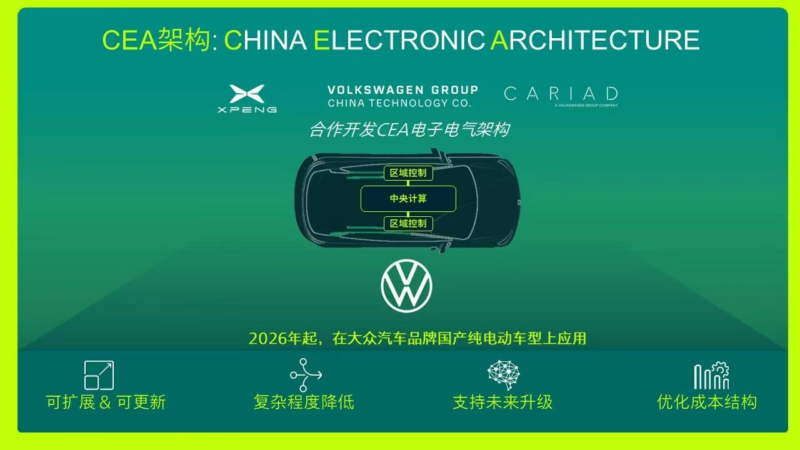
In April 2024, the partners announced joint development of the CEA architecture, with formal agreements signed in July. The architecture uses regional control and quasi-central computing design, reducing in-vehicle controllers by 30%, optimising system costs, and enabling OTA updates for autonomous driving and smart cockpit functions.
Volkswagen is pursuing a multi-pronged strategy in China, maintaining partnerships with long-term partners like SAIC, FAW, and JAC while forging new relationships with technology companies like Xpeng and Horizon Robotics. At Xpeng’s Technology Day in November, XPeng CEO He Xiaopeng announced that Xpeng’s self-developed Turing AI chip had been officially designated for use by Volkswagen.
The collaboration with Horizon Robotics has also entered a new phase. On December 8, at the 2025 Horizon Technology Ecosystem Conference, Han Hongming, CEO of the Volkswagen-Horizon joint venture Carizon, revealed that Volkswagen’s self-developed chip will be based on Horizon’s latest BPU architecture, offering 500-700 TOPS of computing power to support future vision and large language models. Importantly, this chip will be “perfectly compatible” with the CEA architecture jointly developed by Volkswagen and XPeng, supporting L2+ advanced driver assistance and L3/L4 autonomous driving.
Over the past three years, Volkswagen has fundamentally restructured its business model and R&D system. The Volkswagen China Technology Company (VCTC) in Hefei, fully operational since January 2024, has become the group’s largest R&D centre outside Germany.
According to the plan, from 2026 onwards, the first batch of vehicles equipped with the CEA architecture and advanced driver assistance functions will be delivered successively. By 2027, more than 20 electrified intelligent models will be launched. By 2030, the pure electric intelligent vehicle matrix will expand to approximately 30 models, comprehensively covering various market segments.


Follow us for ev updates