




Chinese lidar maker Hesai announced on March 18 a partnership with Niu Technologies to supply lidar sensors for electric two-wheelers, marking a new step in the technology’s spread beyond passenger cars.
Hesai said its FTX fully solid-state blind-spot lidar has been selected for Niu’s products to improve safety perception in urban riding scenarios. The sensor will first be fitted to Niu’s newly launched NXT2. The high-performance NX2 electric motorcycle will use the same sensor.
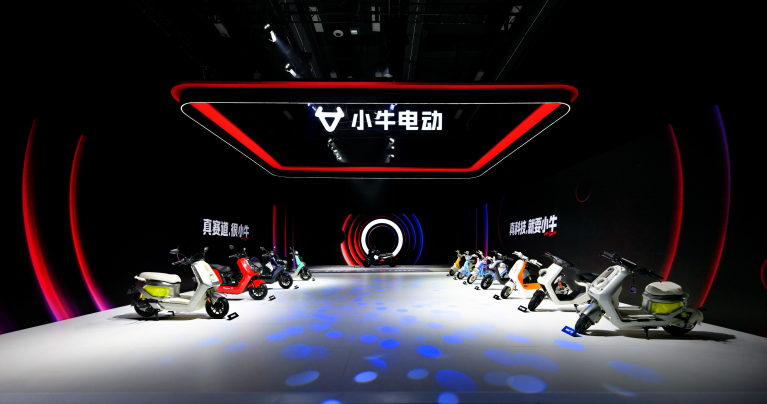
The announcement came alongside Niu’s 2026 new product launch event, where the company unveiled NIU AIOS, an AI operating system for two-wheelers, and introduced new AI-enabled models.
According to Hesai, the FTX offers a maximum field of view of 180° × 140°, allowing the system to detect pedestrians, vehicles, and increasingly complex road conditions in all weather. The sensor’s resolution is more than twice that of the previous generation, while the weight has been reduced by 66%, according to Hesai.
The lidar is designed for blind-spot and short-range perception and can detect low-lying obstacles, helping improve safety on crowded city roads. In Niu’s omnidirectional perception system, the FTX works together with D-Robotics’ Sunrise series intelligent computing chips.
Niu CEO Li Yan said increasingly complex urban traffic means a single perception solution can no longer meet higher safety and intelligence requirements for riders. Hesai CEO Li Yifan said the partnership sets a new intelligence standard for the industry and points toward safer and smarter two-wheeled mobility.
A key reason the technology is now moving into scooters and motorcycles is cost. Hesai said it has reduced lidar prices from hundreds of thousands of yuan in the past to around 200 USD through chip integration and mass production, a drop of about 99.5%. Comparable lidar units cost way over 300,000 yuan (43,600 USD) a decade ago.
Hesai also said lidar penetration in China’s passenger car market reached 19% by the end of 2025, suggesting the technology has entered a phase of broader adoption. The company described the Niu partnership as the first large-scale integration of lidar into the electric two-wheeler sector.
The move highlights how lidar is gradually moving from high-end EVs and robotaxi fleets into more affordable consumer products. In January, BYD filed a lidar option for its Seagull city car, priced at around 10,000 USD, while Leapmotor filed the A05 compact EV with LiDAR earlier this month.
Hesai is one of China’s largest LiDAR suppliers, with its longer-range sensors already used in robotaxi programs including Baidu, Pony.ai, WeRide, and Zoox. Its latest deal with Niu shows that falling sensor costs are beginning to open a much wider market, including the two-wheeler market.
Niu Technologies is a Chinese electric two-wheeler giant that makes e-scooters, e-bikes, and motorcycles. The company also tried to make its own electric car in early 2020, but failed.


Follow us for ev updates