


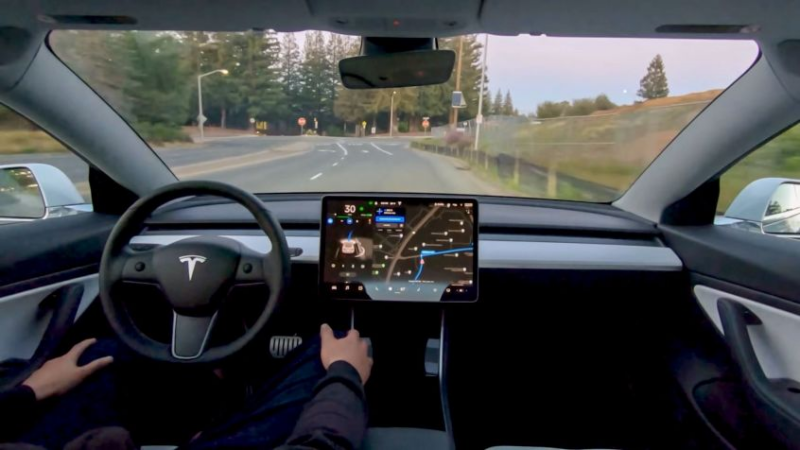
Tesla CEO Elon Musk’s recent claims that the company’s supervised Full Self-Driving (FSD) system could receive approval in China as early as next month have been directly debunked by reliable sources quoted by state media China Daily.
Speaking at the World Economic Forum in Davos, Switzerland, on January 22, 2026, Musk suggested that Tesla’s FSD system requiring driver supervision might soon be approved in China, potentially coinciding with its European approval timeline. However, China Daily said reliable sources told it that this information is “not true.”
This isn’t the first time China Daily has refuted claims about FSD’s imminent approval in China. The publication previously addressed similar rumors in October 2024, when sources revealed that while the Chinese government supports testing certain FSD functions within existing legal frameworks, regulatory approval had not been granted. At that time, relevant assessment work was still ongoing.
Tesla’s own roadmap had projected FSD deployment in China by Q1 2025, pending regulatory approval. However, insiders told China Daily that the progress was not proceeding as rapidly as suggested, with comprehensive evaluations still being conducted on autonomous driving technology, data security, legal regulations, and technical standards.
Key challenges for FSD implementation in China involve the collection of basic geographic information and ensuring data compliance. Currently, Tesla relies on authorized Chinese companies to conduct relevant mapping activities in accordance with China’s Surveying and Mapping Law, which regulates such activities for intelligent connected vehicles.
According to sources close to Tesla quoted by China Daily, Musk had previously proposed to relevant authorities that Tesla be allowed direct access to certain non-sensitive video data for training its autonomous driving system, with government teams conducting comprehensive assessments to ensure data security.
Even earlier, in May 2024, when there was rumours about FSD to be approved in China, China Daily reported that while China might support Tesla in testing “unmanned taxi services” as a demonstration project, full approval for FSD had not been granted.
Editor’s comment
There might be a semantic distinction here, depending on the interpretation of “approval.” Is Musk referring to full operation in China or merely testing on specific roads within the country?
Most Chinese cities are densely populated, with 145 cities having populations exceeding one million, compared to just 9 in the United States. Consequently, traffic conditions in China are considerably more complex than in the US. Currently, the driverless taxi services (with or without onboard safety drivers) approved in China are relatively mature Level 4 (L4) solutions. Even so, last month, a serious accident occurred during Robotaxi testing in Zhuzhou, a city with a population of nearly 4 million. Regulators consequently adopted a more cautious stance, and Robotaxi testing in the city was subsequently suspended.
With respect to population size, Zhuzhou significantly surpasses any city where Tesla FSD is currently undergoing testing, although it’s considered small in China. Furthermore, the autonomous driving solution implicated in the Zhuzhou accident (Baidu’s Apollo Go) is considerably more mature than Tesla FSD, both in terms of operational mileage and other relevant metrics. Evidently, obtaining approval for Tesla FSD in a sizable Chinese city presents a significant challenge.
It is also conceivable that Tesla’s supervised FSD could receive approval for testing within highly restricted, specific areas. If Musk interprets such limited testing as “approval,” then this scenario is plausible. However, the probability of such testing commencing next month is exceedingly low, given that February this year coincides with China’s Spring Festival holiday. It is unlikely regulators would grant approval for anything in that month.


Follow us for ev updates