


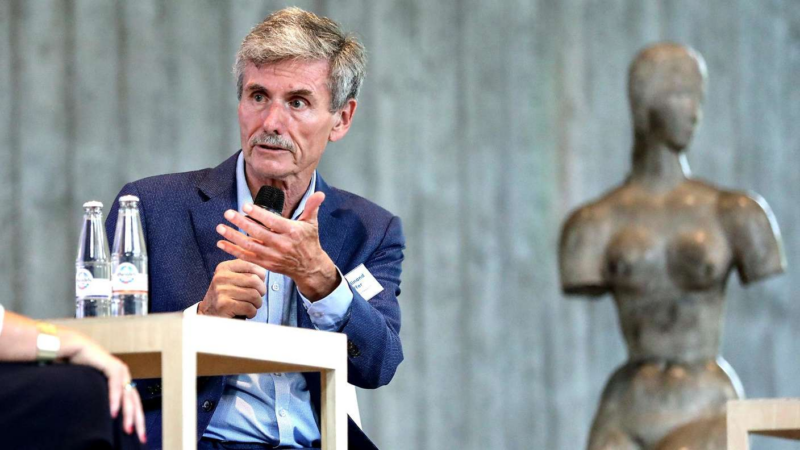
European automakers face a stark technological disadvantage in the electric vehicle revolution, with the continent lagging “at least 20 years behind China” in battery technology, according to renowned German automotive expert Professor Ferdinand Dudenhöffer, who often referred to as the “Auto Pope” (Autopapst) by German media.
In an interview with Chinese newspaper Global Times, Dudenhöffer, director of the Center for Automotive Research in Bochum, Germany, delivered a blunt assessment of Europe’s position in the global EV race. His comments come as Chinese automakers reported breakthrough sales in Europe, with monthly volumes exceeding 100,000 units for the first time in December 2025, capturing 9.5% market share.
“In the battery sector, Europe is 20 years behind China,” Dudenhöffer stated, emphasizing that cooperation with Chinese suppliers has become essential for European manufacturers to remain competitive. This technological gap has created a situation where over 70% of batteries in electric vehicles sold in Europe by 2025 will be supplied by Chinese companies.
The cost advantage held by Chinese manufacturers is substantial, with battery production expenses approximately 30% lower than those of their European counterparts and development cycles shortened by 50%. Meanwhile, European battery manufacturers struggle to gain traction, with Sweden’s Northvolt facing bankruptcy due to technical deficiencies and delivery delays, while France’s ACC has paused factory expansion plans.
Chinese battery giants like CATL and Gotion High-Tech have moved beyond simply supplying components to actively establishing manufacturing presence in Europe. CATL’s joint venture with BMW has already begun production in Germany, while BYD‘s partnership with Stellantis to develop low-cost lithium iron phosphate batteries has entered mass production.
The technology gap extends beyond batteries into other critical areas. “Chinese companies in fields such as automatic driving and smart cockpits, like QCraft, Horizon Robotics, Xiaomi, and Huawei, are leading the trend rather than being dominated by European and American manufacturers,” noted Dudenhöffer.
International Energy Agency data shows China currently controls 75% of global battery production capacity, with particular leadership in lithium iron phosphate battery technology. Despite European efforts to strengthen local supply chains through the Critical Raw Materials Act, battery production costs remain 50% higher than in China, with over 80% dependency on imports for critical materials like lithium and nickel.
“If European automakers continue to rely on inefficient local supply chains, they will completely miss the transition window,” Dudenhöffer warned, suggesting that the ongoing partnerships between Chinese and European firms could transform Europe from a “battery consumption center” to a “Sino-German technology testing ground.”
The professor also highlighted what he calls “Chinese efficiency,” noting that development cycles for Chinese companies can be half as long as their German counterparts. “We can learn a lot from ‘Chinese efficiency,’” he concluded, emphasizing that cooperation between the Chinese and European automotive industries represents a win-win strategy that combines the strengths of both sides.


Follow us for ev updates