


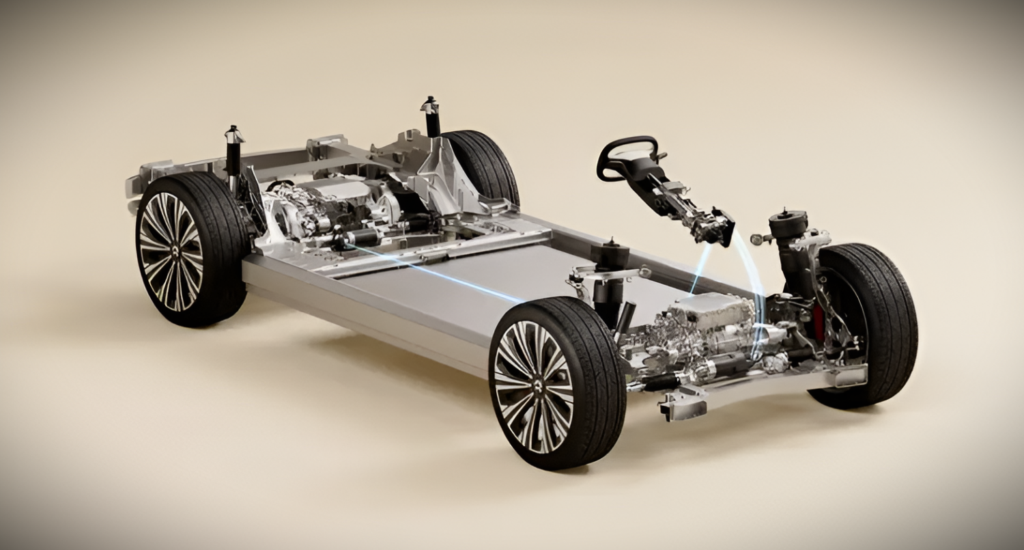


China has released a new national standard for vehicle steering systems, effective July 1, 2026, that removes the previous requirement for a mechanical linkage and allows the use of full steer-by-wire technology. The update includes detailed safety and functional requirements for electronic and electric power-assisted steering systems, as reported by IT-home.
The drafting of the standard involved multiple Chinese automakers and technology companies, including Nio, BAIC, Xpeng, BYD, Geely, Xiaomi, and Huawei, as well as joint-venture operations such as Toyota’s China smart EV centre and Mercedes-Benz China. Participation from a broad range of domestic and international manufacturers reflects the standard’s application across different vehicle types and steering architectures.
Several vehicles currently use steer-by-wire technology, including the Infiniti Q50, IM L6, Nio ET9, and Tesla Cybertruck. The Infiniti Q50 incorporates a redundant mechanical connection, while the Nio ET9 is the first mass-produced model in China to deploy full steer-by-wire technology without mechanical backup. The new standard establishes safety and functional requirements for both traditional and fully electronic steering systems.
The standard emphasises functional safety in line with the latest UN R79 amendments and requires electronic steering systems to comply with ISO 26262 safety levels. It specifies system redundancy and defines expected performance under different failure scenarios, including power supply, control transmission, and energy management malfunctions. Alarm requirements for fully electronic steering systems include addressing battery ageing and performance issues, as well as real-time monitoring of energy management.
Additional revisions clarify test procedures for steering system failures, define measurement requirements for steering effort during faults, and establish functional safety validation protocols. Manufacturers must submit supporting documentation for electronic steering system safety, which is subject to review and random verification testing. The standard also updates terminology and reporting requirements to support consistent implementation.
The update establishes a regulatory framework for vehicles equipped with electronic steering technologies. By removing mechanical linkage mandates and specifying functional and safety requirements, the standard supports the design, testing, and deployment of electronic and electric power-assisted steering systems in both domestic and imported vehicles.


Follow us for ev updates