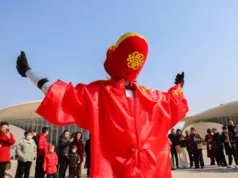
The spectacle was hard to ignore. During China’s recent New Year celebrations, humanoid robots from companies like Unitree, AgiBot, and LimX Dynamics performed synchronized dances, did backflips, and showed off martial arts moves with smooth control, highlighting how quickly China’s robotics industry is moving forward.
This sets up a trillion-dollar question for Tesla (NASDAQ:TSLA). The company’s valuation story has shifted from being mainly an EV manufacturer to positioning itself as the world’s leading “Physical AI” enterprise focusing on robotaxis and humanoid robots. In early 2026, Tesla made a major pivot, sunsetting its flagship Model S and Model X to free up factory space for the Optimus humanoid robot. Elon Musk has recast Tesla’s identity away from a car company and toward an AI robotics platform. In the race for a dominant humanoid robot, is Tesla’s anticipated “Optimus moat” shallower than its $1 trillion valuation suggests? What exactly are investors valuing the company at about $1.3 trillion for?
We think the answer hinges on the distinction between the “body” and the “brain.”
China’s Rapid Hardware Progress
There’s little doubt that Chinese manufacturers are solving the hardware gap in robotics. The recent dancing robots demonstrate advanced mechanical engineering, sophisticated motor control, and robust designs. The maneuvers performed by these robots indicate that these companies have built advanced dynamic balance and powerful actuation systems that are on par with, or even ahead of, Optimus’s current capabilities. These recent developments indicate that the physical challenges of building a capable humanoid form are steadily being overcome.
Chinese companies have also been able to build these robots at scale, with China apparently holding over 80% of the market share of the humanoid robot space last year. China’s established manufacturing ecosystem provides a significant edge. The global supply chain for critical robotic components—actuators and sensors—is heavily concentrated within the region. This allows Chinese startups to iterate faster, move from prototype to small-batch production in months, and potentially outpace Western rivals in scaling hardware. While Tesla targets an eventual $20,000 price point for Optimus, Chinese companies like LimX are already selling base models for competitive prices of about $22,000.
Tesla’s Claimed Advantages
To be sure, performing choreographed routines is very different from truly “working.” The Chinese robot demos show that they excel at movements that appear to be largely pre-programmed or trained for specific actions.
But the real value could come not from the body but from the intelligence behind it. Investors are betting that Tesla’s true differentiator is not the physical robot itself, but the advanced AI “brain” that powers it. The core belief is that Tesla’s edge comes directly from its highly advanced FSD (Full Self-Driving) neural network architecture, which, by most recent accounts, has finally become quite reliable and exceptionally smooth. There are several key differentiators for Tesla.
Tesla has abandoned traditional, rules-based robotics programming. Optimus leverages the FSD v15 neural architecture, a unified “vision-only” system. Just as Tesla cars navigate roads without LiDAR, Optimus uses a suite of cameras and the networks to build a comprehensive 3D understanding of its environment. This could enable the robot to learn continuously and perform tasks in unstructured, dynamic settings without explicit pre-programming for every scenario.
Another one of Tesla’s most significant advantages is its immense computing infrastructure, which includes its Dojo and H100 clusters. Instead of needing to physically train a robot for thousands of hours to learn a new task, Tesla can simulate that task millions of times in a virtual factory environment within minutes. Crucially, since the physics within this simulator is grounded in real-world FSD data collected from millions of Tesla vehicles.
By early 2026, Tesla also began integrating Grok, the advanced AI developed by Elon Musk’s xAI, into the Optimus platform. This adds a crucial “reasoning layer” to the robot’s capabilities. While the FSD stack handles the lower-level motor skills such as walking, grasping, and perceiving, Grok provides the high-level understanding and contextual reasoning. This means Optimus should be able to interpret nuanced verbal commands, understand implied meaning, and make decisions that require a level of common sense currently beyond most hardware-focused robotic systems.
Risks and Shortfalls