


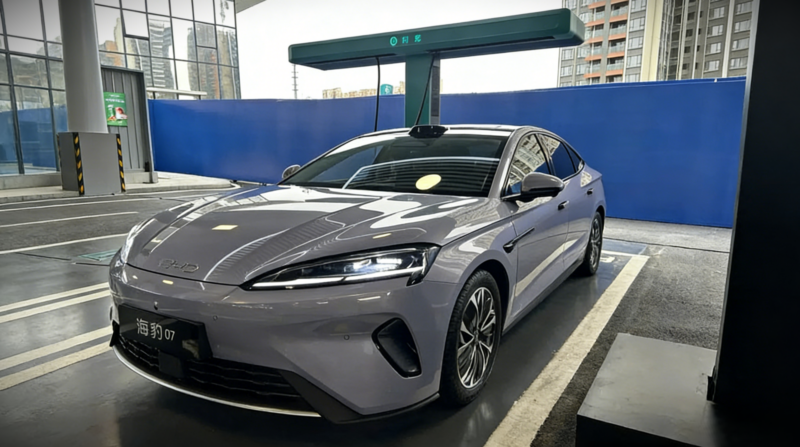
Following the March 5 release of the second-generation Blade Battery, BYD has detailed its “Flash Charging China” infrastructure strategy. During a media briefing in Shenzhen following the launch, Li Yunfei, BYD’s General Manager of Branding and Public Relations, confirmed the company aims to deploy 20,000 megawatt-level charging stations by the end of 2026.
Li shared on social media, characterising battery swapping and flash charging as “different paths to the same destination,” suggesting both models serve the broader goal of electric vehicle adoption. However, the scale of the 20,000-station rollout suggests a shift toward high-speed charging as a primary solution for rapid energy replenishment and grid management.
The 2026 Infrastructure Landscape
While Nio pioneered the swap model, the sector has consolidated into a “Swapping Cartel” of major players, including CATL and Aulton. BYD’s flash charging blitz is designed to outpace the combined reach of these networks within 10 months.
| Operator | Technology | Current Stations (Mar 2026) | End-2026 Target |
| BYD | 1,500 kW Flash | 4,239 | 20,000 |
| Nio | Battery Swap | 3,790 | 4,800 |
| CATL (Choco-SEB) | Battery Swap | 1,020 | 2,500 |
| Aulton New Energy | Battery Swap | 521 | 2,000* |
| CATL (Qiji) | Truck Swap | 305 | 900 |
The “5-Minute” Convergence
The primary value proposition of battery swapping has been its 3-minute turnaround time. BYD’s Megawatt Flash Charge 2.0, paired with the second-generation Blade Battery, has reduced this delta to a statistically negligible margin.
- The Refill Gap: BYD’s hardware achieves a 10% to 70% SOC in 5 minutes.
- Thermal Resilience: A critical weakness for swapping has been reduced battery activity in Northern China. BYD’s new thermal management allows a 20% to 97% charge in 12 minutes at -30°C, effectively “poaching” users in cold-climate markets where swap efficiency often degrades.
- Safety Benchmarking: Blade Battery 2.0 passed a simultaneous Flash Charging and Nail-Penetration Test, maintaining zero thermal runaway after 500 high-power cycles.
Economic Warfare:
The swap model faces significant financial headwinds. Nio’s investment in infrastructure has surpassed 18 billion yuan (2.49 billion USD), yet analysts note a swap station requires ~60 swaps per day to break even; the current network average hovers at 35.
BYD’s strategy bypasses the most expensive barrier to high-power charging: grid upgrades.
- Energy Station Integration: 18,000 of BYD’s stations are “within-a-station” modules.
- Buffering Technology: These units use internal LFP reservoirs to act as “power amplifiers,” drawing a steady 100 kW from the grid while discharging at 1,500 kW.
- Cost Efficiency: BYD claims this reduces installation capital expenditure by 60% compared to traditional high-voltage chargers that require dedicated substations.
Market Positioning: Premium to Mass Market
Nio’s swap network remains a premium “status symbol” for its 1.05 million cumulative owners. However, BYD is democratising high-speed replenishment. Following the Q1 2026 launch of the Yangwang U7 and Denza Z9GT, the second-gen Blade tech is slated for the Song and Qin series in Q2 2026, followed by the Dolphin and Seagull in H2.
By the time CATL scales its “Choco-SEB” swap blocks to 2,500 stations, BYD’s 20,000-unit network aims to have 90% of urban China within a 5 km radius of a 1,500 kW plug.


Follow us for ev updates