


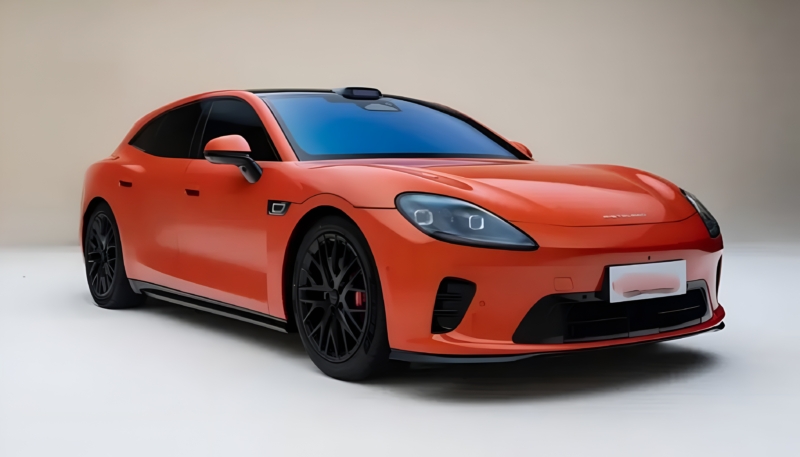
Huawei and GAC unveiled the new Qijing brand and its first vehicle, the GT7 shooting brake, while opening blind orders in China. The model combines Huawei’s Qiankun intelligent vehicle platform with GAC’s manufacturing integration, according to IT-home.
Technical overview
The GT7 integrates Huawei’s Qiankun intelligent vehicle stack and features a performance-oriented electric architecture with a three-motor powertrain. Output figures were not disclosed during the launch event. Energy storage is provided by a Kirin battery jointly developed with CATL, although the battery’s capacity and chemistry were not announced.
The powertrain operates on an 800V high-voltage architecture designed to support 6C fast-charging capability, enabling high-power charging performance once compatible infrastructure is available. Driver-assistance hardware is built around Huawei’s Qiankun intelligent driving architecture. The system includes a 896-line lidar sensor, described by Huawei as the highest line-count lidar prepared for mass-produced vehicles, and forms part of a hardware platform intended to support future L3 automated driving functions once regulations allow.
Vehicle perception and software systems run on Huawei’s Qiankun Chitu computing platform, paired with a HarmonyOS-based cockpit and AI assistant integration.
Product context
The GT7 adopts a shooting-brake body style that combines a fastback roofline with wagon-style cargo proportions. The vehicle measures 5050 mm in length, 1980 mm in width, and 1470 mm in height, supported by a 3000 mm wheelbase. According to the presentation, the proportions emphasise a wide stance and long wheelbase intended to balance styling with interior space.
The shooting-brake layout allows a lower roofline than SUVs while maintaining rear cargo capacity. Design elements include Huawei’s XPixel intelligent projection headlight system and a simplified interior layout centred on a HarmonyOS digital cockpit.
Market positioning
No official price has been announced for the GT7. Qijing positions the model as a premium intelligent shooting brake targeting China’s emerging electric wagon segment. Domestic competitors include the Zeekr 001 and Nio ET5 Touring, which helped establish early demand for electric wagon-style vehicles in China. Imported comparators in the broader performance wagon category include the Porsche Taycan Cross Turismo.
The GT7 represents the first production vehicle under the Qijing brand, a collaboration structure in which Huawei supplies the intelligent vehicle technology platform while GAC manages engineering integration and manufacturing.
Industry context
Huawei’s automotive ecosystem continues to expand through partnerships with multiple manufacturers. Saic recently introduced the Z7 and Z7T wagon models, integrating Huawei technology and adopting a body style reminiscent of shooting-brake designs.
Huawei has also expanded its perception hardware program. The company confirmed that updated versions of the Maextro S800 sedan and Aito M9 SUV will adopt an 896-line mass-produced lidar, described as the highest line-count sensor prepared for production vehicles.
Outlook
The GT7 will appear in showrooms starting in April, before test drives begin ahead of deliveries planned for June. Key specifications such as total system power, battery capacity, and driving range remain undisclosed, leaving the final competitive positioning of the model within China’s electric shooting-brake segment to be clarified closer to launch.


Follow us for ev updates