


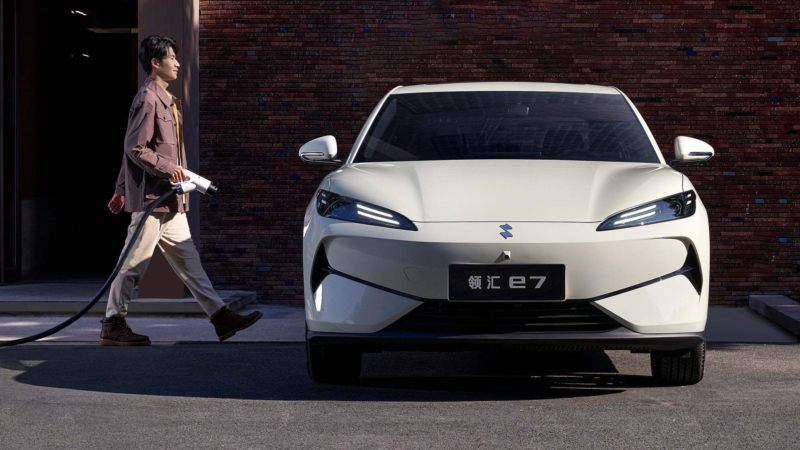
BYD ride-hailing brand Linghui disclosed that the e7 electric sedan will support the recently launched flash charging technology. It will be able to charge from 10% to 97% in nine minutes. The Linghui e7 is a 4.8-meter vehicle with an e-motor for 130 kW (174 hp).
BYD’s ride-hailing sub-brand Linghui was exposed in early January 2026 as the world’s biggest new energy vehicle maker applied for sales licenses for four models. In February, the Linghui brand was officially revealed in China. Shortly after, Linghui shared official images of the e9 BEV sedan and the M9 PHEV minivan. On March 10, BYD revealed that the Linghui e7 sedan will adopt flash charging.
Linghui e7 with flash charging
The Linghui e7 was officially unveiled in China as a taxi-oriented battery-electric vehicle. It uses the second-generation Short Blade battery pack, which supports fast DC charging. The new model will be able to charge at BYD’s recently revealed flash charging stations with a maximum output of 1,500 kW per charging connector.
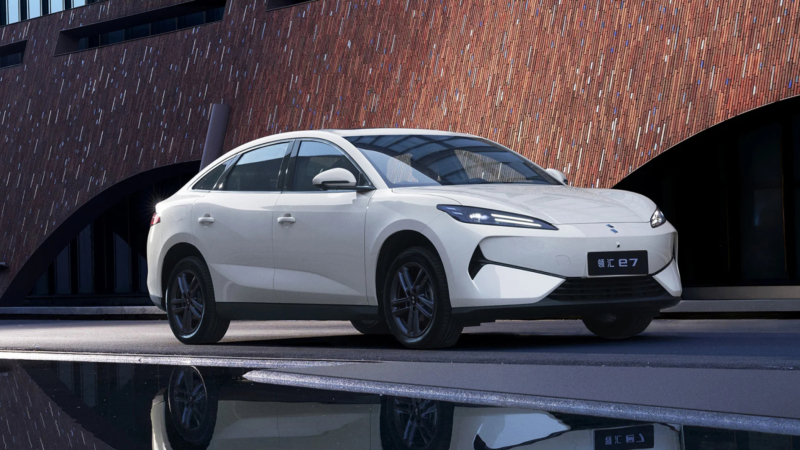
The Linghui e7 sedan will be able to charge from 10% to 70% in approximately five minutes. It will take around nine minutes to charge 10 – 97%. This charging speed applies pressure to the recent CATL battery swap project for low-cost commercial vehicles. CATL’s swap stations store 14 – 30 batteries, capable of performing a replacement in 1.5 minutes.
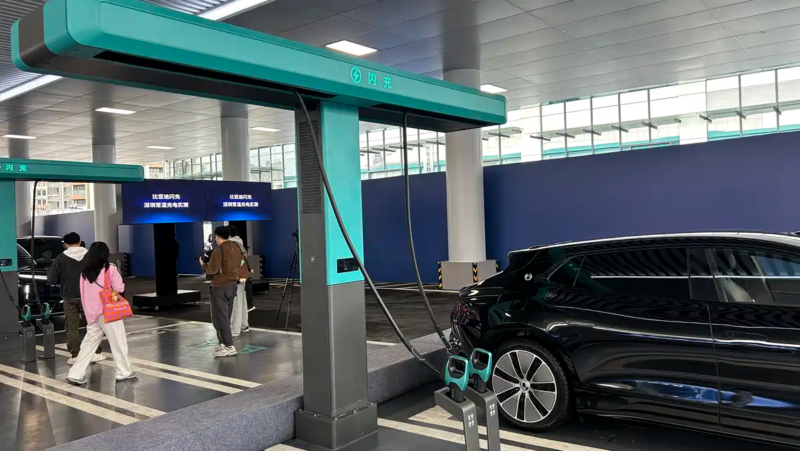
The battery replacement is still faster than the charging session. However, swap stations have two drawbacks. The first is the high cost of infrastructure development. And the second is the necessity of adapting the cars’ design to battery swap requirements. CATL aims to install 2,500 battery swap stations in China in 2026. Meanwhile, BYD has already deployed 4,239 flash charging stations in China with a plan to establish 20,000 charging stations this year.
More about the Linghui e7
The Linghui e7 follows the design language of BYD’s Ocean series. It has thin headlights, a closed front end, and a single taillight unit. Dimensions of the e7 are 4780/1900/1515 mm. The wheelbase reaches 2,820 mm. For clarity, it is 91 mm longer than the Skoda Octavia.
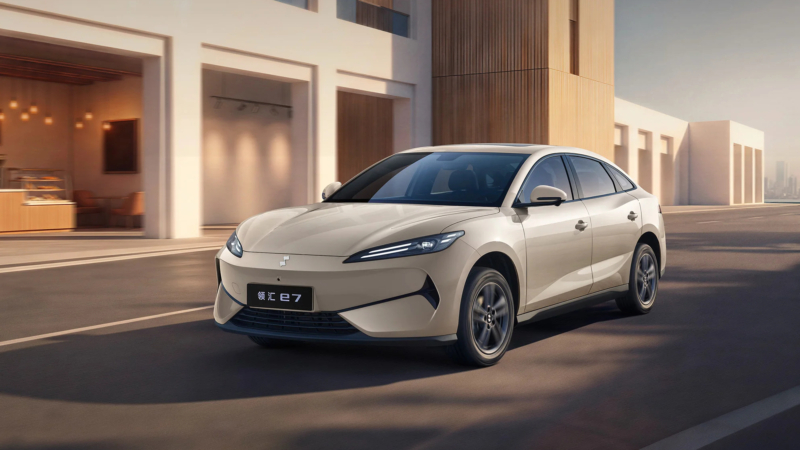
The entry-level Linghui e7 offers a 100 kW (134 hp) electric motor. Two LFP battery variants are available. Their capacity has yet to be revealed. However, the range was disclosed by the Chinese regulator. The standard e7 will offer 450 km of range, while the long-range variant will boast 520 km of range. CarNewsChina expects the e7 to adopt two battery variants: 51.3 kWh and 61.4 kWh.
The Linghui e7 will also be available with a more powerful electric motor for 130 kW (174 hp). It will be able to run up to 550 km on a single charge. We expect this variant to be offered only with a larger 61.4 kWh battery pack.
Follow us for ev updates