


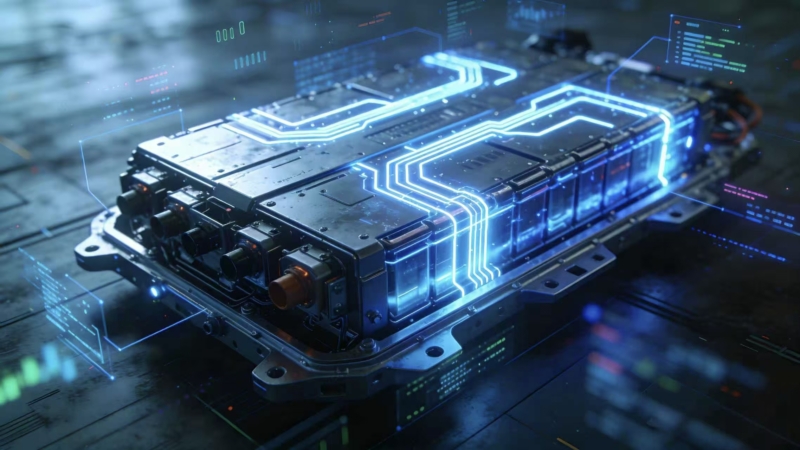
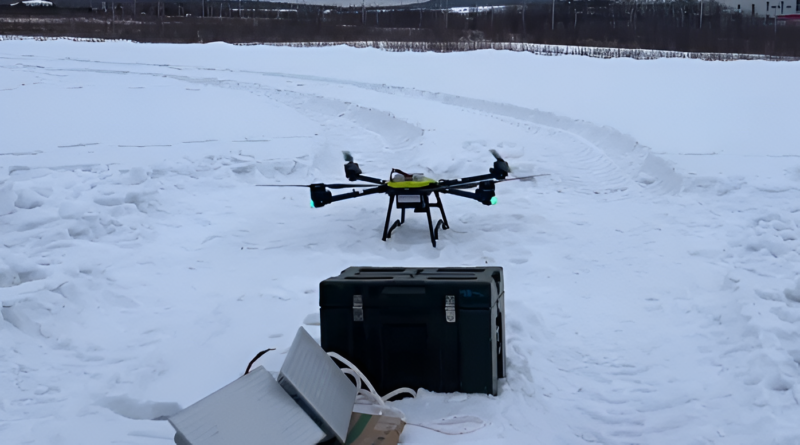
Chinese researchers have developed a liquid-solid-state (semi-solid-state) lithium battery capable of sustained operation in extreme cold, retaining over 85 % of effective capacity after eight hours at –34 °C. The work was led by the Dalian Institute of Chemical Physics, Chinese Academy of Sciences (CAS), and reported by Global Times. Validation occurred through industrial drone flights and robotics simulations, confirming a reliable energy supply without external insulation.
The battery system combines low-temperature electrolyte formulations, a liquid-solid functional separator, and an AI-based power management system. Together, these components stabilise energy output under subzero conditions, addressing sharp capacity drops and start-up failures typical of conventional lithium-ion packs below –20 °C. Project leader Zhang Meng noted that the liquid-solid architecture mitigates reduced activity and the risk of total failure in extreme cold.
Demonstrated applications include drones for inspection, logistics, and emergency communication, as well as robotics operating in high-altitude or cold-season environments. Researchers highlight plug-and-play compatibility, enabling deployment without additional thermal insulation.
While the initial focus is on industrial equipment, the liquid-solid architecture is directly relevant to electric vehicles (EVs) in cold regions. Conventional EV packs often lose 50–80% of their capacity at temperatures below –20°C, reducing range and reliability. By sustaining high capacity at –34 °C, this design offers a pathway to improved EV performance in high-latitude markets, subject to scaling and integration with vehicle thermal management systems.
Benchmark Context
| Battery Type | Capacity Retention at –20 °C | Capacity Retention at –34 °C |
|---|---|---|
| Conventional EV Lithium-ion | 20–50 % | Often fails to start |
| CAS Liquid-Solid (Semi-Solid) Design | >85 % | Validated in drone and robotics tests |
The technology represents an advancement in cold-climate energy storage research in China. Adaptation for multi-hundred-kWh EV packs would require further validation, safety testing, and platform integration. Beyond automotive applications, potential applications include 3C electronics, logistics drones, and outdoor equipment, thereby reinforcing China’s role in advancing battery systems for extreme environments.
The technology remains in the demonstration phase, with future development aimed at scaling for broader industrial and automotive use, including potential deployment in northern-region EVs, high-altitude robotics, and cold-season logistics operations.


Follow us for ev updates