


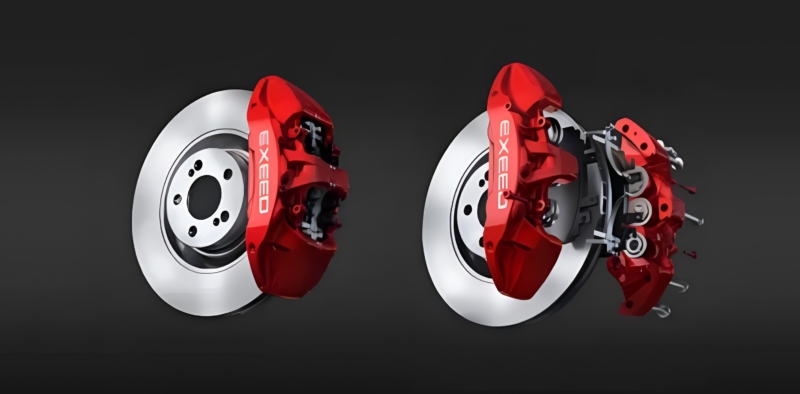
Several Chinese automakers and suppliers are advancing Brake‑by‑Wire (BBW) technology through Electronic Mechanical Braking (EMB) systems, with multiple projects targeting small‑scale mass production by 2026. EMB is a fully brake‑by‑wire system in which service braking force and its transmission are powered entirely by electronic actuators and control systems, replacing conventional hydraulic circuits. While all EMB is brake‑by‑wire, not all brake‑by‑wire systems use fully electronic actuators. This shift reflects a broader transition in China’s passenger vehicle sector toward electrified and software‑integrated chassis systems.
In May 2025, China issued the mandatory standard GB21670‑2025, Technical Requirements and Testing Methods for Passenger Car Braking Systems, which takes effect on January 1, 2026. The standard defines the term “Electrical Transmission Braking System (ETBS)” as a braking system powered solely by electrical storage and controlled by the driver. It also establishes minimum requirements for redundancy, reliability, and safety validation. With this framework, OEMs and suppliers can certify EMB systems for mass production in passenger vehicles.
Chinese suppliers are rapidly preparing EMB for production. Orient‑Motion Technology has built production lines and partnered with Dongfeng Liuzhou Motor and Geely‘s Farizon to deploy EMB systems across multiple vehicle platforms. Jiongyi Electronic Technology has completed durability testing and ISO26262 certification for its fully dry EMB products. Motion Technology has validated its EMB assembly line for mass production, while Watson Rally has entered the calibration and production validation stage, according to Research and Markets.
Beyond Chery’s Exeed EX7, which has been publicly announced as the first mass production model to use EMB, other upcoming Chinese vehicles are expected to adopt similar systems. Chery ET Series high‑end EVs have passed EMB testing under GB21670‑2025, making them potential candidates for 2026 EMB-equipped versions. Kaiyi Automobile, a Chery subsidiary that produces passenger cars and SUVs primarily for domestic and export markets, and U Power, a Shanghai‑based EV battery-swapping and energy-solutions provider, are working with Beijing West Industries (BWI) to integrate EMB systems into new models, enabling four‑wheel independent control without hydraulics. Industry sources also note the Li Auto L9 Livis as a potential future EMB candidate, though this remains unverified.
International suppliers and OEMs are contributing to EMB development and to brake‑by‑wire systems more broadly. Beijing West Industries has announced dual‑motor EMB systems for integration into Kaiyi and U Power platforms in 2026, featuring full four‑wheel independent control and elimination of hydraulic components. Other global firms are exploring hybrid and fully electronic brake‑by‑wire solutions to integrate autonomous safety and software-defined chassis functions in future vehicles.
Despite progress, technical complexity remains a primary hurdle. Actuator performance, functional safety, system redundancy, and cost control continue to challenge developers. These engineering factors will influence the pace at which EMB transitions from prototype demonstrations to commercial applications across the wider market.


Follow us for ev updates