


On January 26, 2026, four US-based subsidiaries of Chinese automaker BYD formally filed a lawsuit against the federal government in the US Court of International Trade (CIT), challenging a series of tariff executive orders implemented under the International Emergency Economic Powers Act (IEEPA). The CIT disclosed information about the lawsuit on February 2.
According to court documents obtained by Chinese magazine Caijing, the plaintiffs are BYD’s four core North American operating entities: BYD America LLC (responsible for North American distribution and services), BYD Coach & Bus LLC (commercial electric vehicle manufacturing), BYD Energy LLC (battery operations), and BYD Motors LLC (import and sales). The defendants include the US federal government and key officials from the Department of Homeland Security, Customs and Border Protection, the Office of the US Trade Representative, and the Treasury Department.
The lawsuit, filed under case number 26-00847, challenges nine executive orders and their amendments issued since February 2025. These include border tariffs targeting Mexico (Order 14194) and Canada (Order 14193), and several China-specific tariffs covering fentanyl (Order 14195), “reciprocal tariffs” (Order 14257), and subsequent retaliatory tariffs (Order 14266). The suit also addresses country-specific tariff orders targeting Brazil (Order 14323) and India regarding Russian oil transactions (Order 14329).
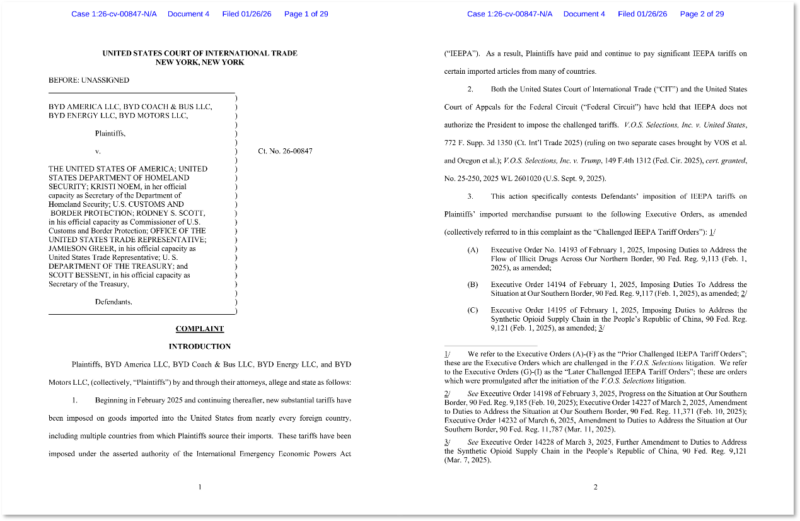
BYD is requesting that the court rule the defendants lack statutory authority to impose tariffs under the IEEPA framework and declare all the challenged tariff orders invalid as ultra vires actions. The company seeks permanent injunctions against implementing these measures and economic relief, including refunds of all IEEPA tariffs collected from the plaintiffs, plus interest and reasonable litigation costs.
This lawsuit is part of a massive wave of litigation in US trade law, with thousands of importers filing similar cases since 2025 to challenge the administration’s legal authority to impose tariffs using IEEPA. A case filed by a small New York wine importer, V.O.S. Selections, in April 2025 has already won favourable rulings in both the CIT and Federal Circuit Court of Appeals, which found the President lacks authority to impose tariffs under IEEPA. The government has appealed to the Supreme Court, which heard oral arguments on November 5, 2025, with a final ruling expected in the first half of 2026.
To avoid inconsistent judgments and conserve judicial resources, the CIT has issued a “stay order” on thousands of similar cases nationwide, including BYD’s. All cases are procedurally frozen pending the Supreme Court’s final ruling on the V.O.S. case.
According to Caijing, despite this procedural hold, BYD’s lawsuit serves important strategic purposes. It preserves the company’s right to seek remedies for imports already cleared or soon to be cleared, and it extends the scope beyond the executive orders covered in the V.O.S. case to include more recent tariff orders targeting Brazil, India, and other countries.
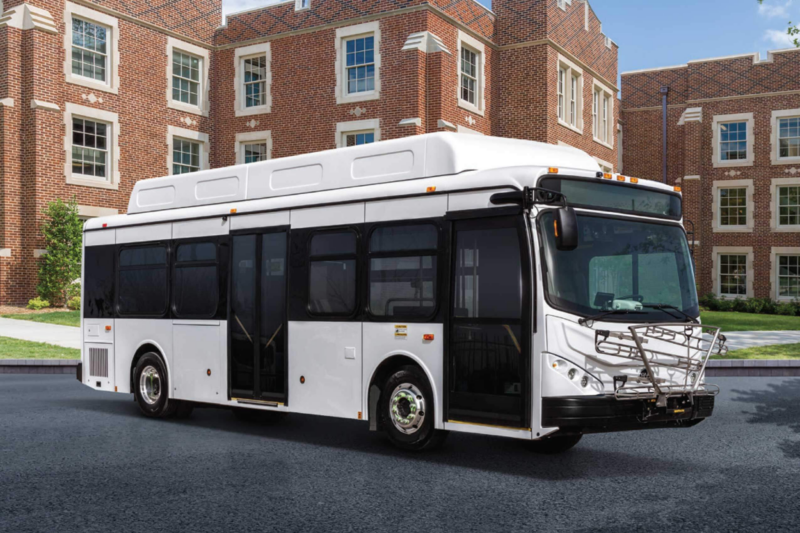
BYD’s US operations focus primarily on commercial vehicles and energy infrastructure. Since 2013, the company has operated a manufacturing plant in Lancaster, California—one of North America’s largest electric bus factories with an annual capacity of about 1,500 vehicles and employing over 750 local union workers. Currently, BYD’s main US business involves electric buses and energy storage systems for municipal transit and utility projects, with North American annual revenues estimated between 500 million and 1 billion USD.
According to Caijing, a favourable ruling could create breakthrough opportunities for BYD’s passenger vehicle business in the US and neighbouring countries. Last year, Mexico became BYD’s largest single overseas market, with exports exceeding 120,000 vehicles.
If BYD prevails in its lawsuit, products from its Brazilian factory could enter the US market with tariffs below 15%, and its previously suspended Mexican factory project could overcome its main policy uncertainty, creating conditions for potential revival.


Follow us for ev updates