



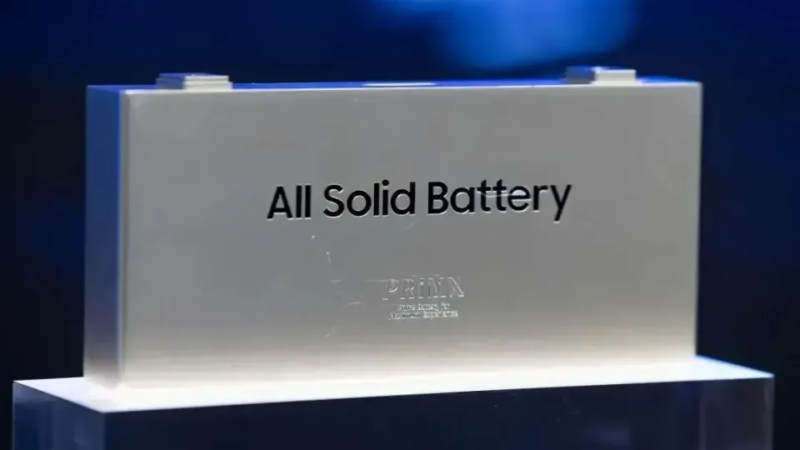
A collaborative research team led by Professor Chen Wanghua from the Faculty of Physical Science and Technology at Ningbo University, alongside researchers from Ningbo University of Technology and Ningbo Institute of Technology, has announced a breakthrough in solid-state lithium battery anode materials.
According to Chinese media Global Times,the team has successfully developed a novel silicon nanowire anode featuring a three-dimensional “breathable” structure, inspired by natural respiratory mechanisms, offering a promising new pathway for the development of high-performance silicon anode all-solid-state lithium batteries. The findings were recently published in the international energy materials journal, Energy Storage Materials.
All-solid-state lithium batteries are widely regarded by scientists and industry as the “ultimate goal” for next-generation battery technology due to their enhanced safety, higher energy density, and superior cycle performance. Among potential anode materials for these advanced batteries, silicon stands out for its exceptionally high theoretical capacity—ten times that of traditional commercial graphite anodes—and excellent chemical compatibility. However, silicon’s practical application has been severely limited by its dramatic volume expansion, exceeding three times its original size during charge and discharge cycles. This expansion leads to severe mechanical stress, interface detachment, and rapid degradation of electrochemical performance.
“If we liken a lithium battery to an energy storage warehouse, silicon is the recognized ‘super porter’ with immense storage potential,” explained Professor Chen Wanghua. “However, this ‘giant’ has an extremely volatile temperament: when absorbing lithium ions during charging, silicon’s volume violently expands by over three times. With repeated charge-discharge cycles, silicon acts like a balloon constantly inflating and deflating, eventually ‘collapsing’ due to exhaustion, leading to a sudden death of the battery’s lifespan.”
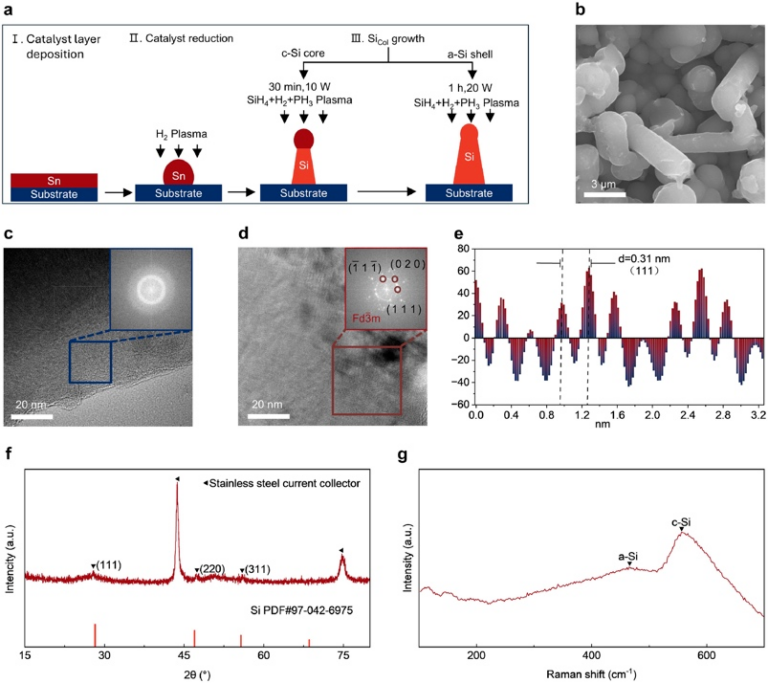
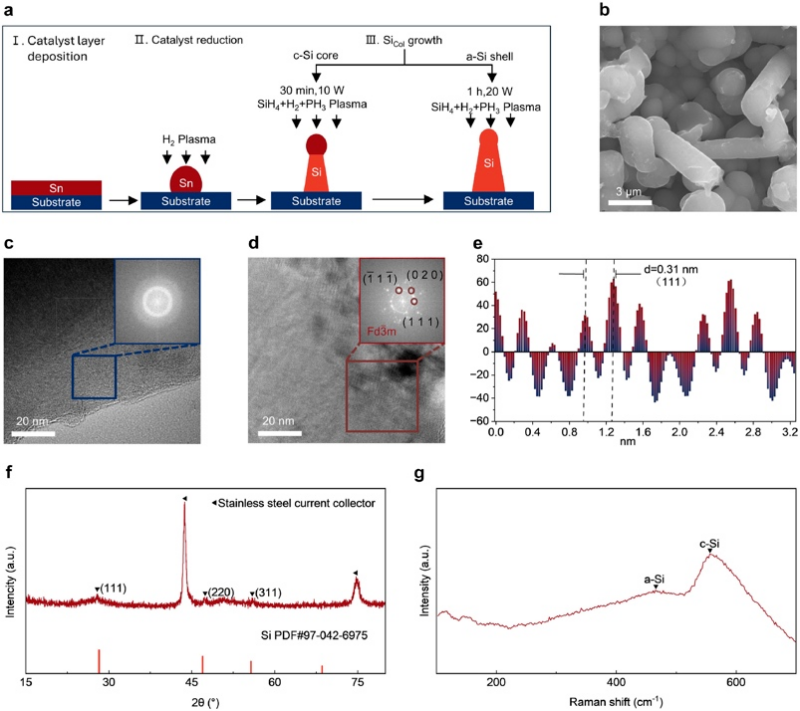
To address this critical challenge, the research team devised an innovative solution to enable silicon to “breathe freely” within a rigid solid-state environment. Utilizing plasma-enhanced chemical vapor deposition (PECVD) technology, they designed and fabricated a novel three-dimensional columnar silicon architecture that integrates directly with the current collector. This design boasts a “dual-phase” core-shell structure, prepared through a two-step PECVD process.
“We moved away from traditional ‘silicon powder’ and instead made silicon ‘stand’ like trees in a forest, interwoven to form a three-dimensional network on the current collector,” Professor Chen elaborated. “These nanowires have abundant voids between them, much like installing countless ‘breathing valves’ inside the battery. When lithium ions surge in, the silicon nanowires can expand into these reserved spaces without crushing the surrounding electrolyte.”
Experimental results demonstrate that this columnar silicon anode exhibits exceptional electrochemical performance and practicality. The developed battery proved capable of continuously supplying power even when bent or cut with scissors, showcasing remarkable mechanical robustness and safety.
This research establishes a new paradigm for unifying ion transport kinetics with mechanical integrity through architectural design. It provides a feasible and practical technical path for the development of high-energy, long-life all-solid-state silicon-based lithium batteries, bringing the next generation of battery technology closer to reality.


Follow us for ev updates